
The free walking tour is the most popular way to start exploring Madrid. In two or three hours on foot, a local guide pulls together half a millennium of history and leaves you with a clear mental map of the city centre: how to get around, where to eat, what to visit next and what to skip. There's no fixed admission price — at the end of the tour you pay what you think is fair. Simple and efficient.
This guide covers how the model works, which routes are worth taking, what tip is reasonable, and when a private tour pays off over the free option. It's written for travellers who land in Madrid and want to make the most of their first day.
What is a free walking tour?
A free walking tour is a guided city walk with no upfront price. The guide doesn't charge in advance; at the end, each participant leaves a tip based on the quality of the experience. The model works because the guide's incentive is real: if they don't convey the value of the city, they don't get paid.
In Madrid this format has become the entry point of choice for travellers. What you see in two hours with a good guide easily beats a full day on your own, and the stories told along the way aren't in any guidebook. That's why free tours are usually the first activity booked by visitors who land in the capital without a fixed plan.
How does it actually work?
The process is straightforward: book your spot online (or sign up at the meeting point if there are seats left), arrive ten minutes early, follow the guide for 2-3 hours along the route and at the end leave whatever tip you think is fair. No surprises, no cancellation fees if you give notice, and groups are capped so the experience stays personal.
Tipping reference in Madrid is between €8 and €12 per person. If the tour has been outstanding, €15 or more is very welcome. For groups larger than six, a private tour usually works out better per person and gives you a much more tailored experience.
Practical tip: book ahead, especially in high season (summer and Holy Week). Groups have a hard cap and the better guides fill up days in advance. If you're a couple or a small group it doesn't matter much when you sign up; if you're more than six or you need a specific time slot, check availability early.
The best routes in Madrid
Madrid has neighbourhoods and historical periods different enough that there isn't a single free tour: there are routes for every kind of traveller. Here are the seven most popular and who each one is for.
Habsburg Madrid free walking tour. The essential classic. Starts at Puerta del Sol and covers Plaza Mayor, Plaza de la Villa, the Royal Palace and the Almudena Cathedral. In two and a half hours you'll grasp 500 years of Spanish history without getting bored. The perfect route for a first contact with the city. Length: 2.5 hours. Start: Puerta del Sol.
Monumental Madrid — Bourbons free walking tour. The natural follow-up to the Habsburg tour. Covers 18th- and 19th-century Madrid, with Gran Vía, Paseo del Prado, the Retiro and the great museums. Ideal if you've already done the Habsburg one and want to understand Madrid's transition into a modern capital. Length: 2 hours. Start: Plaza de Cibeles.
Medieval Madrid free walking tour. A walk through pre-Habsburg Madrid: the Muslim heritage, the remains of the Arab walls and the medieval origins of the city. A focused tour for travellers interested in the oldest layer of the capital, before the great imperial expansion. Length: 2 hours. Start: Plaza de la Villa.
Literary Quarter free walking tour. For culture lovers. Cervantes, Lope de Vega and Quevedo all lived here. The neighbourhood keeps its cobbled streets and has lines of poetry set into the pavement. A more intimate, literary route with smaller groups. Length: 2 hours. Start: Plaza de Santa Ana.
Spanish Civil War free walking tour. The most substantial of the themed tours. Walks the key spots of the Madrid front, the resistance and the bombing of the capital during the war. For travellers with genuine historical interest. Length: 2.5 hours. Start: Glorieta de Cuatro Caminos.
Haunted Madrid free walking tour. The night tour par excellence. Urban legends, dark stories and the city's most mysterious corners under the streetlights. Works particularly well for repeat visitors or anyone after a different evening plan. Length: 2 hours. Start: Puerta del Sol.
Lights of Bohemia free walking tour. The literary, bohemian route through the Madrid of Valle-Inclán and the Generation of '98. Historic taverns, café tertulias and the late-19th-century Madrid that gave the novel its name. A cultured, niche profile — and memorable. Length: 2 hours. Start: Plaza de Santa Ana.
How much should you tip?
There's no fixed rule, but there is a clear reference. If the tour met your expectations and you learned something new, a reasonable tip is between €8 and €12 per person. If the experience was outstanding — the kind you'll recommend to friends back home — €15 or more is in generous territory. Below €5 is a low tip and usually reflects a tour that didn't deliver.
The system works on honesty. The guide invests 2-3 hours of their time, their knowledge and their ability to keep a group engaged throughout the route. Around 90% of satisfied travellers pay between €8 and €15. If you're on a family or private booking, the price is agreed in advance with the agency and the tipping system doesn't apply.
Practical detail: have the tip ready in cash. Many guides accept Bizum or digital payment, but cash is faster at the end of the tour and avoids awkwardness. Use €10 per person as your mental anchor; raise it if the tour was great, lower it if it wasn't.
Why a free tour over other options
Instant context. A local guide gives you the historical and cultural frame you need to understand what you're seeing. No audioguide replicates that: the guide adapts the pace, answers questions and recommends where to eat based on your profile.
Orientation. After the tour you know how to navigate the centre and walk away with dozens of local recommendations for restaurants, bars and corners that don't show up on Google Maps. For first-time visitors, that information saves hours of searching.
Flexible economics. You pay based on your assessment, with no upfront commitment. It works especially well for tight budgets or travellers undecided about how much to spend on their first activity.
Social encounters. Free tours are shared experiences. It's not unusual for groups to grab a beer together afterwards, especially among solo travellers or couples looking to meet people. For many visitors, the social component is as valuable as the tour itself.
5 key tips to make the most of it
Arrive ten minutes early. Say hi to the guide, find your spot in the group and start without last-second rushing.
Bring water and comfortable shoes. It's 2-3 hours of walking on cobbled streets. Clothing can be any style, footwear is what matters.
Ask questions. The best moments of any tour happen when someone in the group asks. Local guides have incredible stories they only tell when prompted.
Have the tip ready in cash. Many guides accept Bizum, but cash is faster at the end of the tour and avoids awkwardness.
Leave a review afterwards. On Google, TripAdvisor or wherever you booked. It helps the guide and guides the next travellers thinking of booking.
Free tour, private tour or audioguide
The free walking tour is the best first activity if you're solo, as a couple or in a small group and it's your first time in Madrid. Price is flexible (tip), the group is mixed and the social factor is high. What you lose in personalisation you gain in variety: the guide adapts the talk to the average group profile, not to you specifically.
A private tour makes sense from six people up, for families with children, or when you travel with a very specific interest (food, architecture, political history). It's more expensive in absolute terms but cheaper per person, and the experience is fully tailored: adaptable routes, flexible pace, exclusive attention. If Madrid is part of a longer trip and you have only one day, a private tour optimises that time clearly.
An audioguide is the cheapest option and the least memorable. It works if you want full autonomy or prefer not to interact with a guide. You lose interaction, local recommendations and any adaptability. For a first visit to a city like Madrid it's the least rewarding choice.
Beyond Madrid: day trips
If your trip allows more than a day in Madrid, the surrounding cities are a must. All three are less than ninety minutes away and going with a local guide changes the experience completely compared to doing it on your own.
Toledo, seventy kilometres from Madrid (33 minutes by AVE high-speed train from Atocha), was the imperial capital under Charles I. Jewish quarter, mosque, Gothic cathedral and El Greco's legacy coexist in a UNESCO World Heritage city. It's the most complete day trip if you're after historical density.
Segovia, ninety kilometres away (35 minutes by AVE), has the Roman aqueduct — built without mortar over two thousand years ago — and the alcázar that inspired Disney's Cinderella castle. Plus the best gastronomic stop in central Spain: roast suckling pig from a wood-fired oven.
Ávila, one hundred and ten kilometres away (1h 30 by train), keeps the best-preserved medieval walls in Europe: two and a half kilometres of eleventh-century Romanesque masonry, walkable along the top. Birthplace of Saint Teresa of Ávila and one of the quietest options if you arrive saturated with mass tourism.
If you only have one day and want to optimise, the Toledo + Segovia or Ávila + Segovia combos work well with transport and guide included. If you have two, the natural split is one day in Toledo and another in Segovia, with or without Ávila.
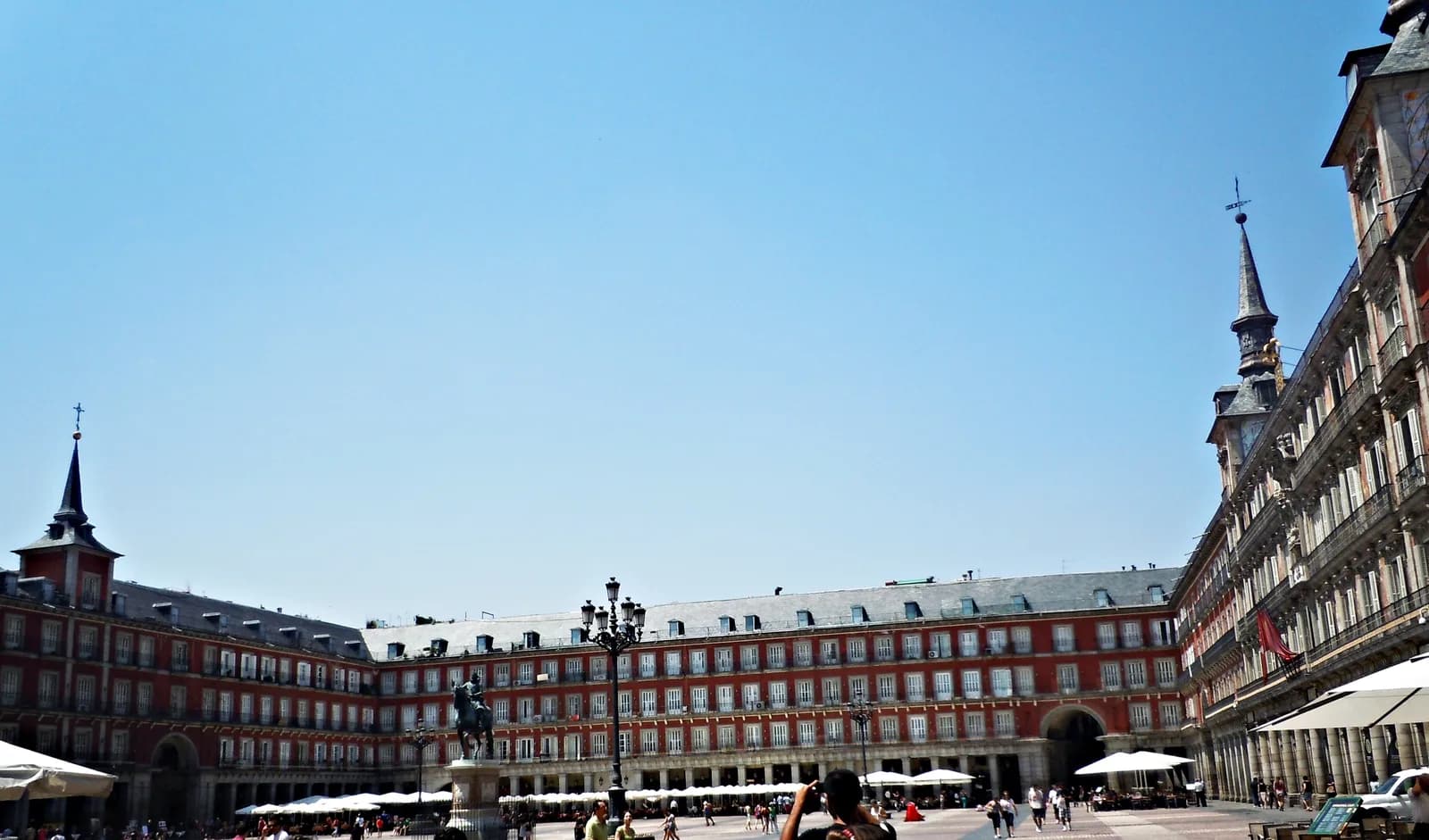
Header photo: Plaza Mayor in Madrid, by Nemo, via Wikimedia Commons (CC BY-SA 4.0).