
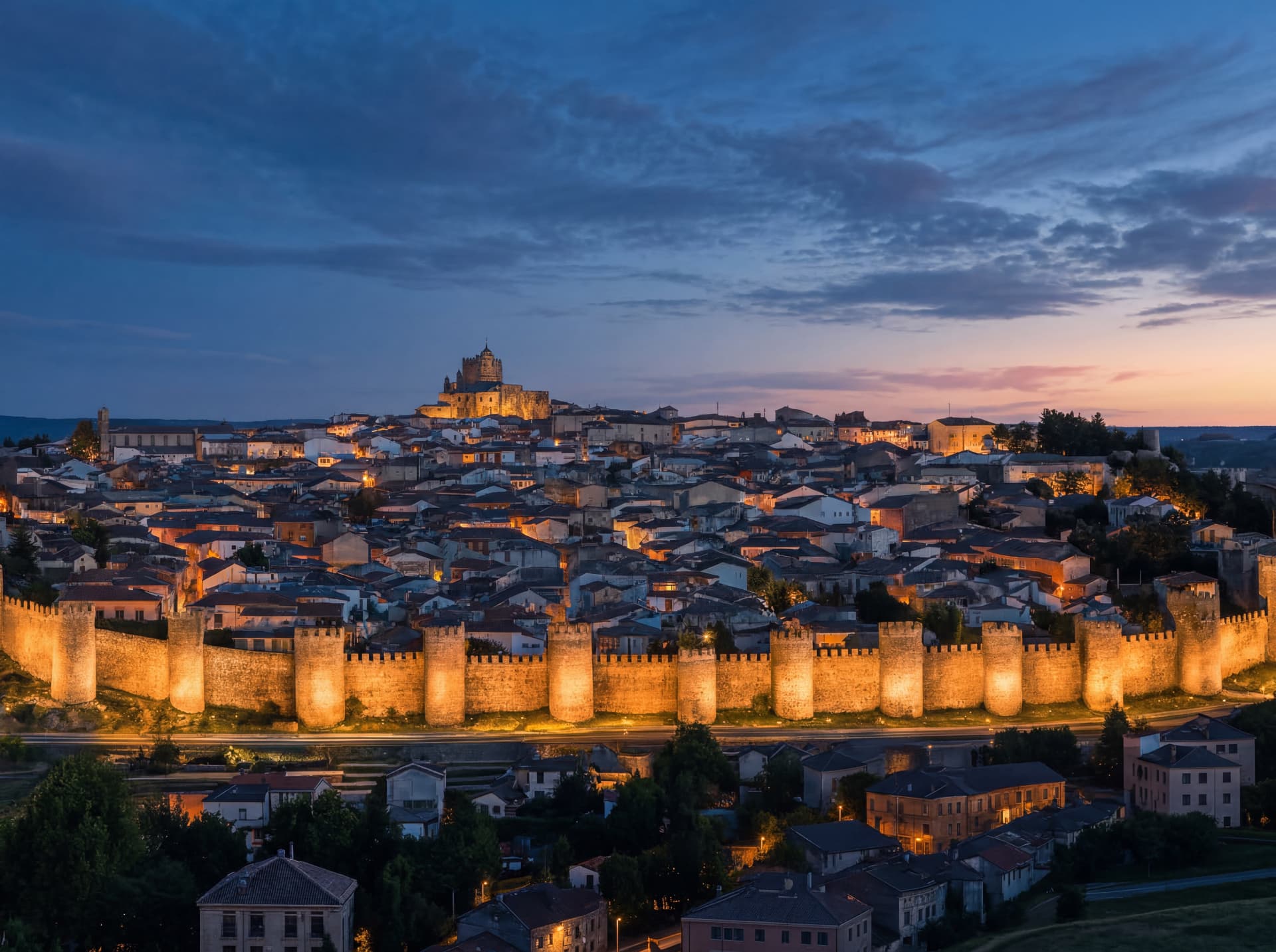
Ávila is the most compact of the three great day trips from Madrid, and that's good news: everything essential fits inside the walls and can be walked in a day without stress. It's also the calmest and most Castilian of the three; its history and the why behind every stone are in the Ávila from Madrid guide.
The idea that organises the day is simple: the morning for the walls and the heart of the city; the afternoon for the mystical Ávila of Saint Teresa; and sunset for the perfect photo from the Cuatro Postes. If you're not yet sure how to get there, we cover it in how to get from Madrid to Ávila.
Before you set off: three keys for your day in Ávila
Wrap up more than you think. Ávila is the highest and coldest provincial capital in Spain (1,130 m). It cools down at sunset and the wind blows up on the adarve, even in spring and summer; bring an extra layer. We cover the seasons in the best time for day trips from Madrid.
Comfortable, closed shoes. You'll be going up and down steps and walking on uneven ground on the walls: leave the slippery soles at home.
Decide on your wall ticket and check the hours. Walking the adarve is ticketed (€8, reduced €5, under-12s free) and in winter it closes on Mondays; the last entry is 45 minutes before closing. If you're going on a low-season Monday, rethink the order of your day.
Morning: climb the walls and walk the adarve
Start with the walls first thing, before the groups arrive. It's the monument that defines Ávila and it deserves time: 2.5 km of perimeter, 88 semicircular towers and 9 gates raised from the 11th century onwards, the best-preserved medieval walled enclosure in Europe.
Up top, along the adarve, you can walk around 1,700 metres split into two sections that aren't connected to each other: one runs from the Casa de las Carnicerías to the Puerta del Carmen (the longer one) and the other from behind the Cathedral to the Puerta del Alcázar. You go up via the Puerta del Alcázar, the Puerta del Carmen or the Casa de las Carnicerías; set aside about 45-60 minutes.
The adarve gives you two views in one: inward, the roofs and bell towers of the old town; outward, the Castilian plateau opening up to the sierra. Local-guide tip: look at the cimorro, the Cathedral's apse, built into the wall itself like another tower. In Ávila, the main church is also part of the defences.
Mid-morning: the old town and the Cathedral of El Salvador
Come down from the walls to the Mercado Chico, Ávila's main square, and wander the medieval layout towards the Cathedral. Distances are short: everything fits inside the walled quarter.
The Cathedral of El Salvador is the first Gothic cathedral in Spain (12th century) and the only one conceived at once as a church and a fortress: its apse is that cimorro you already saw from the walls. General admission €5 (reduced €3); open 10:00 to 20:00, until 21:00 in summer.
Inside, in about 40 minutes, look for the 'blood and bone' stone —the reddish-and-white caleña of the apse—, the ambulatory, the sacristy and the tomb of El Tostado, the work of Vasco de la Zarza.
Lunch: Ávila IGP rib steak and yemas de Santa Teresa
Time to sit down. The star dish is the Ávila rib steak (Carne de Ávila IGP, from the avileña-negra ibérica breed), one of the finest cuts in Spain; if you prefer something heartier and spoonable, the El Barco beans —also IGP-protected— are the other great speciality.
For dessert, the yemas de Santa Teresa: egg yolk and sugar in a recipe of convent origin, the city's most famous sweet.
Tip: move a little away from the most touristy squares towards side streets for better-value set menus. A meal with rib steak comes to around €20-30 per person; book ahead if you're going at the weekend.
Afternoon: the Saint Teresa route and the Romanesque
The afternoon is for Ávila's other great layer: the mystical city of Teresa of Jesus. The Convent of Santa Teresa stands on the house where the saint was born in 1515; the church and the relics room are free to enter, and the Teresian Museum costs €2 (closed Mondays).
A short walk away, the Basilica of San Vicente is the peak of Castilian Romanesque (12th century), built on the site of the martyrdom of the holy siblings Vicente, Sabina and Cristeta. Don't miss the polychrome cenotaph or the doorway. Admission €2.50 (free on Sundays).
If you have energy and time to spare, the Royal Monastery of Santo Tomás sits a little outside the walls, to the southeast: it was the Catholic Monarchs' summer residence and holds the tomb of Prince John and three cloisters (admission €4, open every day). It needs about 30-40 minutes extra on foot or a short taxi; if you're tight on time, prioritise Santa Teresa and San Vicente inside the old town.
Sunset: the Cuatro Postes viewpoint
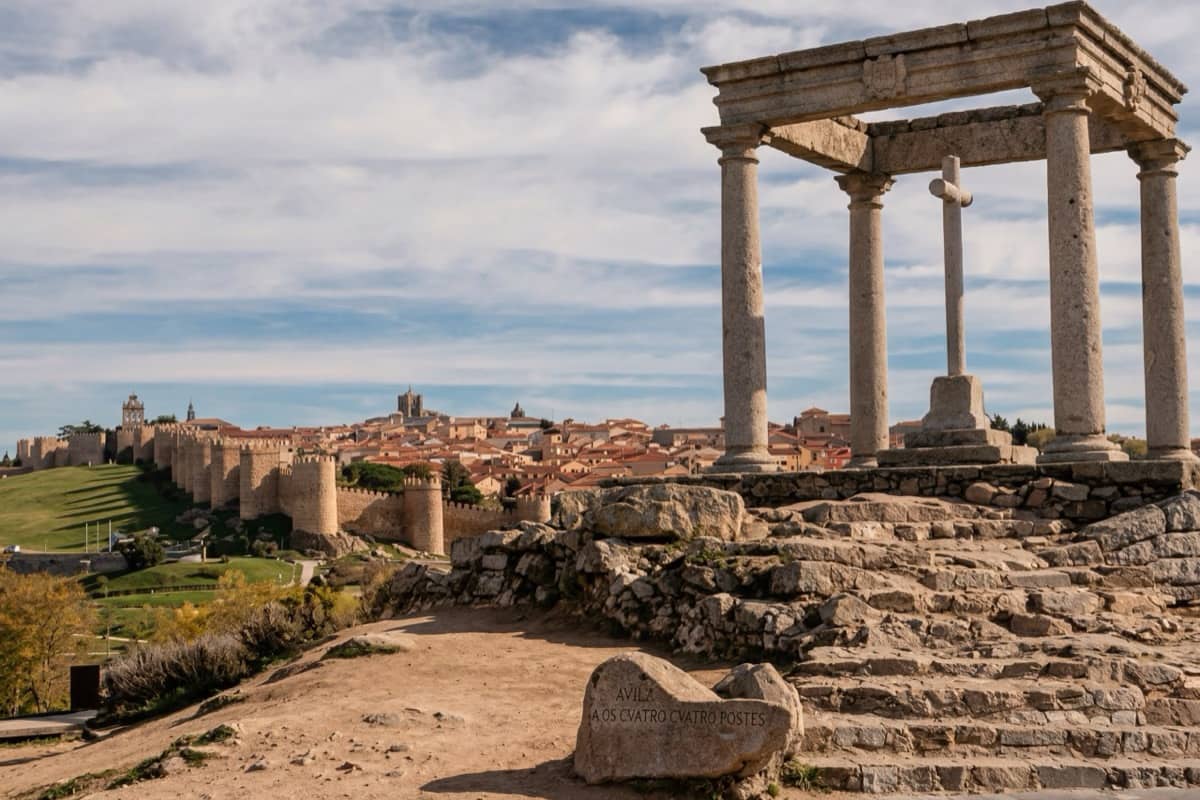
End the day by crossing the River Adaja over the Puerta del Puente to the Cuatro Postes shrine (16th century), about 15 minutes on foot from the walls. It's free and it's the best view of Ávila.
From here you see the whole stretch of wall in profile, with the city outlined and the Sierra de Gredos behind: the shot that appears on every postcard. Go with the last light, when the golden stone lights up; bring something warm for the altitude chill.
It's the first stop on the guided tours, but on your own it works just as well as a finale before the train home. If you walk back, plan the route with some daylight left.
Independently or on a guided tour?
On your own you gain total freedom over timings and a lower base cost; it's ideal if you already know the city or enjoy organising the day yourself.
With a guide you gain the context you can't see at a glance: why the wall is where it is, who Teresa was, what the cimorro hides. And you skip the logistics.
If you're short on time, the most efficient option is to combine Ávila with Segovia in a single day; and if you're still torn over which city to prioritise, compare them in Toledo, Segovia or Ávila. If you would rather have transport sorted and a guide (the guided walk is in Segovia; in Ávila there is a stop at Cuatro Postes and around 60 minutes of free time), see the options in our Ávila day trips from Madrid, with free cancellation up to 24 hours before.
Frequently asked questions
Can you see Ávila in one day? Yes. It's the most compact of the three cities and everything essential fits inside the walls in an unhurried day. If you're stringing day trips together, its counterpart is what to see in Toledo in one day.
How much does it cost to climb Ávila's walls? General admission is €8 (reduced €5; under-12s free). In winter it closes on Mondays and the last entry is 45 minutes before closing.
How long does it take to walk the adarve? Around 45-60 minutes for the sections open to the public (about 1,700 metres in two parts), plus time for photos.
What should you eat in Ávila? The Ávila IGP rib steak (avileña-negra breed) is the star dish and, for dessert, the yemas de Santa Teresa.
How do you get to the Cuatro Postes viewpoint? By crossing the River Adaja over the Puerta del Puente, about 15 minutes on foot from the walls. It's free and offers the best view at sunset.
Frequently asked questions
Can you see Ávila in one day?
Yes. It is the most compact of the three great day trips from Madrid: everything essential fits inside the walls and can be walked in an unhurried day. Mornings for the walls and Cathedral, afternoons for the Ávila of Saint Teresa, and sunset for the Cuatro Postes.
How much does it cost to climb Ávila's walls?
General admission is €8 (reduced €5; under-12s free). In winter the walls close on Mondays and the last entry is 45 minutes before closing. Up top, the adarve runs about 1,700 metres in two sections that take 45-60 minutes to walk.
What should you see in Ávila in one day?
The adarve along the walls (2.5 km perimeter, 88 towers), the Cathedral of El Salvador (€5, the first Gothic cathedral in Spain), the Convent of Santa Teresa, the Romanesque Basilica of San Vicente (€2.50) and, at sunset, the Cuatro Postes viewpoint.
How do you get to the Cuatro Postes viewpoint?
By crossing the River Adaja over the Puerta del Puente, about 15 minutes on foot from the walls. It is free and gives the best view of the city: the whole stretch of wall in profile with the Sierra de Gredos behind, best in the last light of day.
Related day trips
Ávila and Segovia Day Trip from Madrid – Full Day Tour
Discover two World Heritage cities in one day: medieval walls, Roman aqueduct, Alcázar, cathedrals and free time to explore at your own pace.
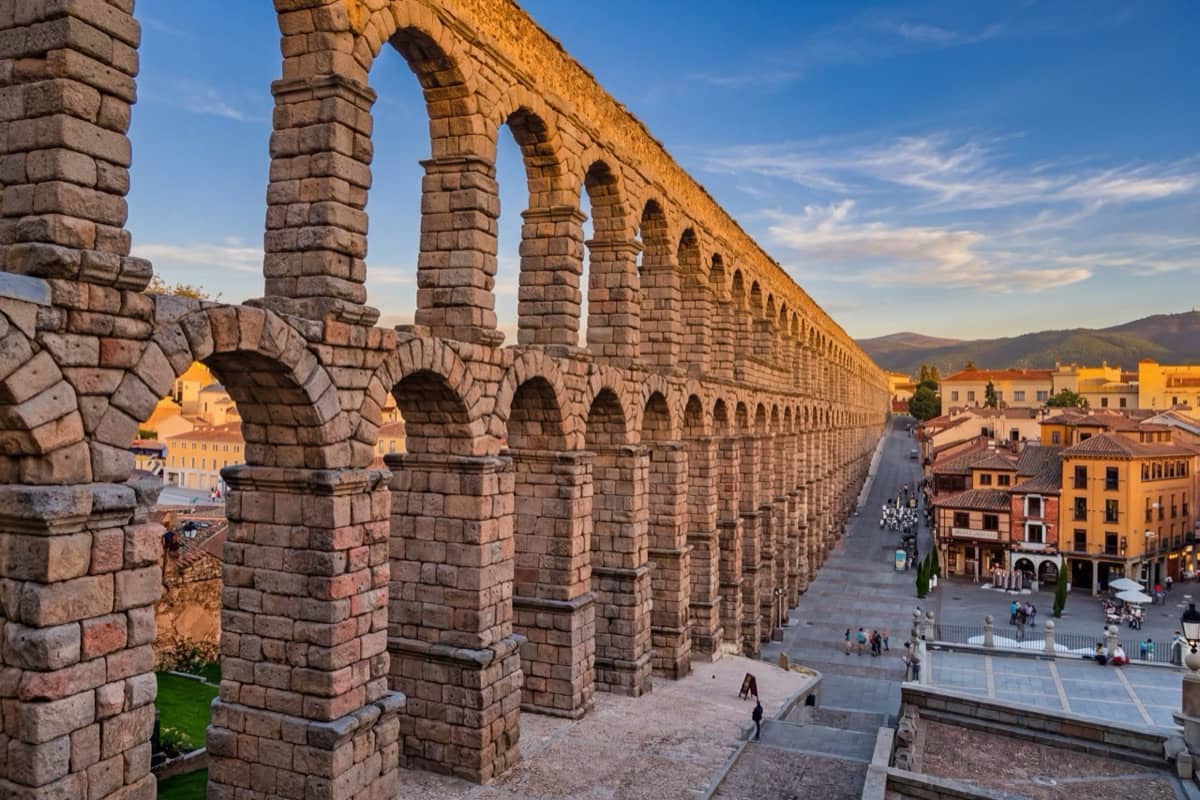
Segovia Day Trip from Madrid – Full Day with Guide and Alcázar Option
Discover Segovia on a full-day trip from Madrid including transport, professional guide, guided walking tour and free time. Optional: Alcázar of Segovia entrance (30 min), visited during your free time.
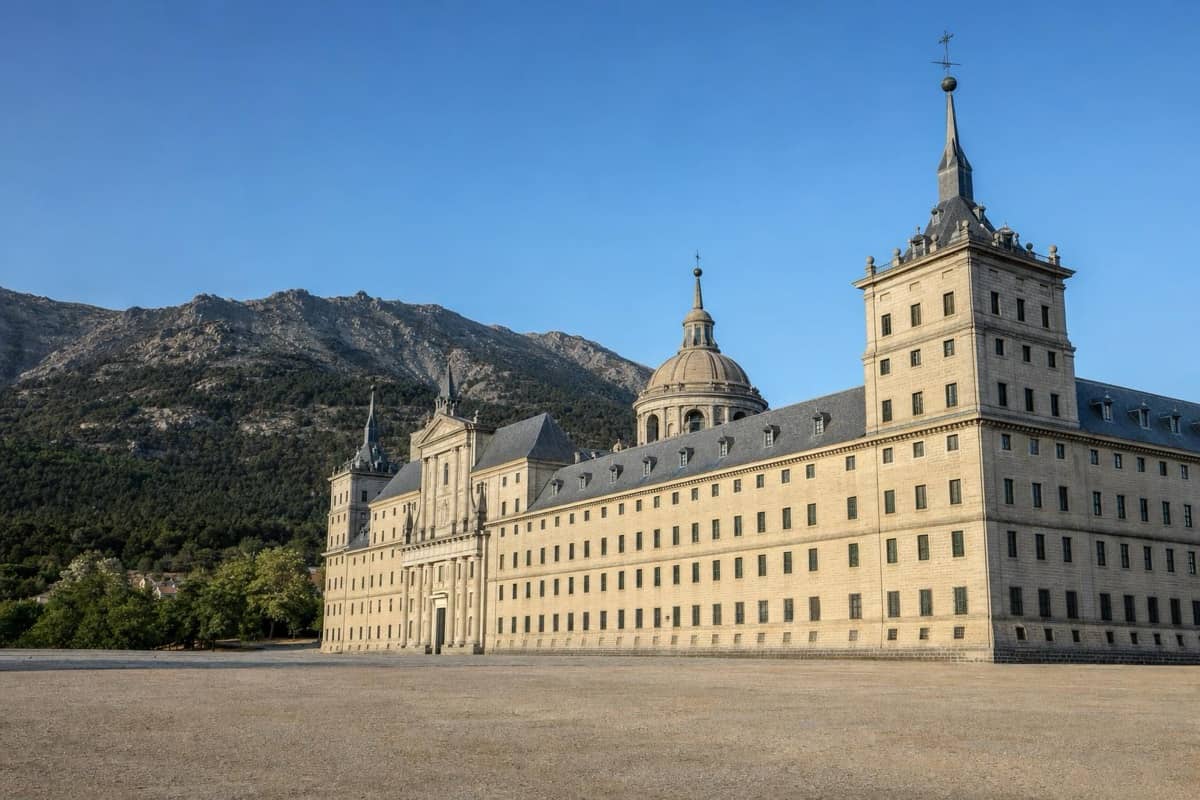
El Escorial, Valley of the Fallen and Segovia from Madrid – Full-Day Trip
El Escorial, the Valley of the Fallen (Valle de Cuelgamuros) and Segovia in one day from Madrid, with a guided walk at each stop and the option to add guided visits inside the Monastery and the Alcázar of Segovia.
Staying in Madrid? Madrid sightseeing bus (Big Bus) from €26